
Ceramics are not a new material. AlN ceramic substrate has been commercially proven in IGBT modules, high-power LEDs, and power modules for many years; the high power density brought by AI computing simply amplifies its value. As a key category of aluminum nitride advanced packaging materials, AlN ceramic substrates have a performance ceiling closely tied to the purity, oxygen content, and sintering process of high-end aluminum nitride powder.
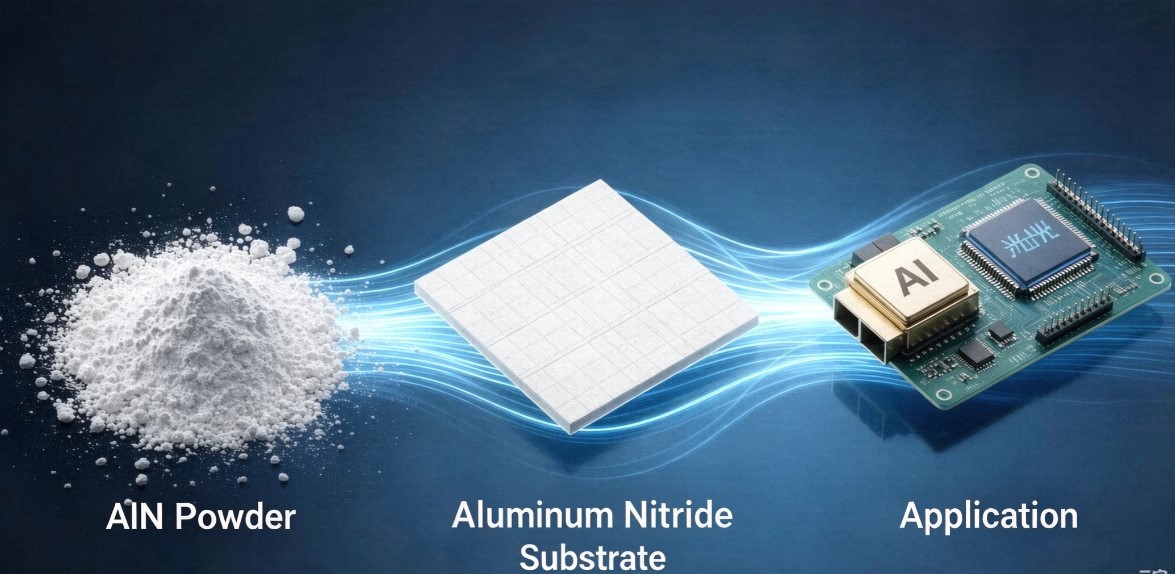
First strength — Thermal conductivity: Substrates fired from aluminum nitride powder can reach 170–230 W/(m·K), hundreds of times that of FR-4. In structures such as power modules where the chip is directly mounted on a ceramic substrate, the first stage of heat extraction from the chip typically relies on this electrically insulating base close to the junction.
Second strength — CTE matching: AlN CTE is approximately 4.5 ppm/°C, of the same order of magnitude as silicon (~3 ppm/°C, varying slightly by temperature range). This significantly reduces interfacial stress and solder-joint cracking risk during thermal cycling; actual reliability still depends on solder material, structural geometry, and temperature profile.
Third strength — System value: Every small reduction in the thermal resistance of the heat-spreading base translates into less throttling for high-power chips. The value delivered by high thermal conductivity AlN is “full-performance” compute value, not just a material cost delta. Of course, this benefit depends on the combined effect of the chip’s power curve, cooling solution, and throttling strategy — it cannot be determined by a single material layer alone.
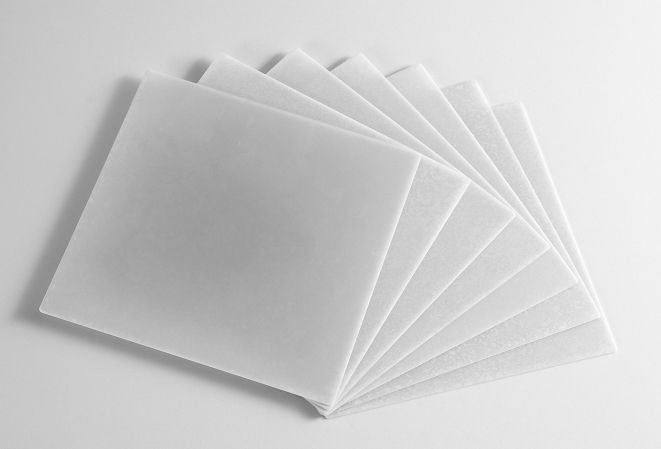
Accordingly, in certain power/advanced-packaging evaluations, and based on a specific analytical framework, the value split for aluminum nitride ceramic substrate and ceramic electronic substrate is roughly 60% thermal optimization and 40% signal-integrity optimization. This also explains why customers specify “low loss, low dielectric constant” in drawings/specifications: AlN has a dielectric constant of ~8–9 with extremely low loss, providing stable electrical insulation and a low-interference environment in package bases and support structures. That said, “low dielectric constant” here is mainly relative to ceramics such as alumina; AlN is not an absolutely low-k material.
Xiamen Juci manufactures High Purity AlN Powder , AlN Granule, Thermal Conductive Filler and AlN Ceramics . Please contact us if you have any requirements.
Contact: Jenny Qin / 진현혜
Phone: +86 151-5177-8700
Wechat ID: JENNY-8866
Xiamen Juci Technology Co., Ltd.
Email: qinxianhui@chinajuci.com
Website: www.jucialnglobal.com
WhatsApp : +8618250812806
WhatsApp : wechat: JENNY-8866
Email : chenxiaofang@chinajuci.com
Email : qinxianhui@chinajuci.com
Tel : +8618250812806
Tel : +8615151778700